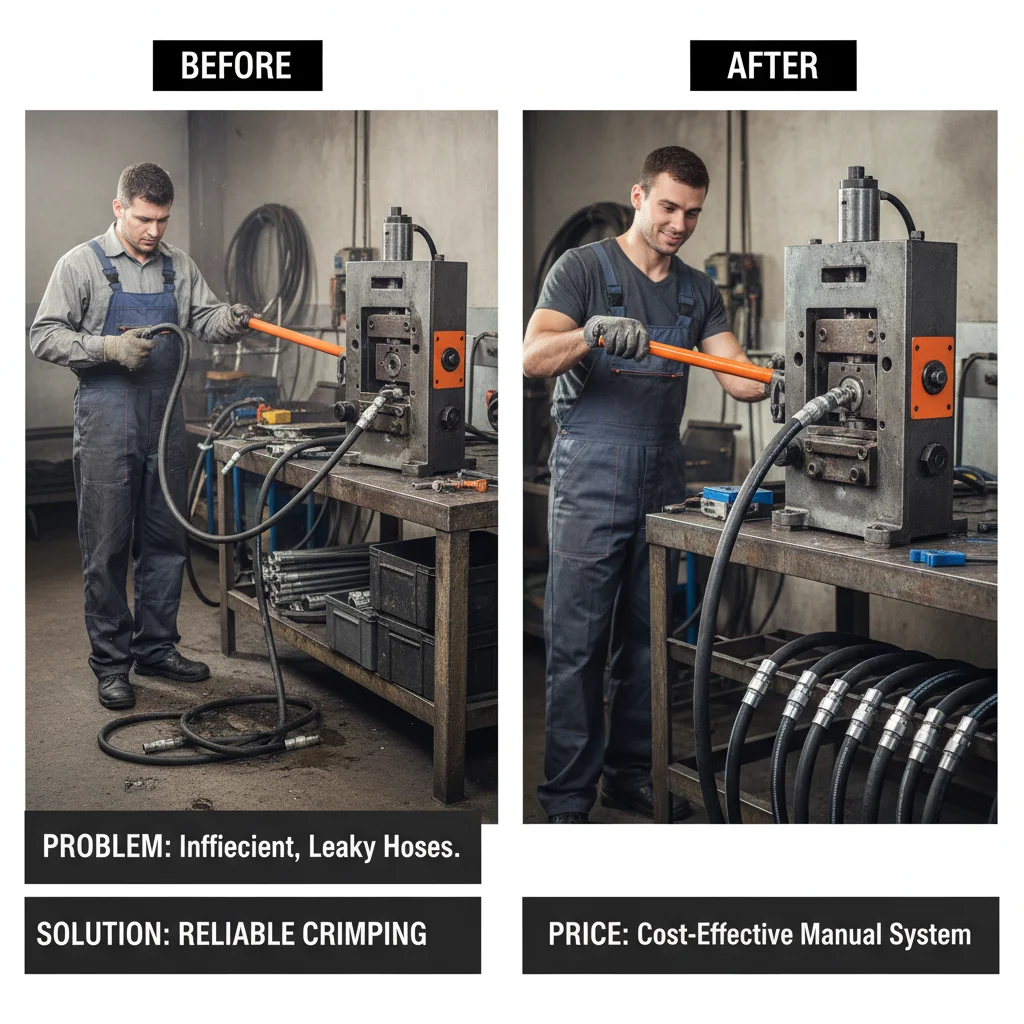
In the demanding world of industrial fluid power, the precision of hose preparation is not merely a matter of convenience but a critical safety requirement. A high-quality hydraulic hose pipe machine ensures that every cut is perpendicular and clean, preventing the internal misalignment that often leads to catastrophic leaks in high-pressure systems. By transitioning from manual cutting to automated precision, workshops can significantly reduce material waste and operational risks.
Globally, the reliance on hydraulic systems in mining, construction, and heavy manufacturing has surged, driving the need for standardized processing equipment. The integration of a professional-grade hydraulic hose pipe machine allows operators to handle everything from standard 1-wire hoses to reinforced 4-wire high-pressure lines with consistent accuracy. This standardization is essential for maintaining the integrity of hydraulic circuits across diverse industrial applications.
Understanding the technical nuances of hose cutting—from blade material to motor power—empowers maintenance managers to optimize their workflow and increase ROI. Whether utilized in a fixed industrial plant or a mobile service vehicle, the right hydraulic hose pipe machine transforms a bottlenecked pre-assembly process into a streamlined, safe, and highly efficient operation.

Global Relevance of Hydraulic Hose Pipe Machine
The global industrial landscape is heavily dependent on hydraulic power for heavy-duty lifting, excavation, and precision molding. As ISO standards for hydraulic safety become more stringent, the demand for a precise hydraulic hose pipe machine has moved from being an "advantage" to a "necessity." Inconsistent cuts in high-pressure hoses can lead to fitting failure, resulting in expensive downtime or severe workplace accidents.
From the mining sectors of Australia to the automotive factories of Germany, the ability to rapidly and accurately prepare hoses is a key indicator of workshop productivity. By implementing a dedicated hydraulic hose pipe machine, companies can ensure that 1-wire to 4-wire hoses are prepared with zero-leak potential, meeting the rigorous demands of modern fluid power engineering.
Defining the Industrial Hose Cutting Solution
A hydraulic hose pipe machine, such as the WILLEX POWER DZW-C300, is a specialized piece of equipment designed to execute perfectly square, perpendicular cuts on reinforced rubber hoses. Unlike manual shears or knives, which often crush the hose wall or leave an angled edge, these machines use high-speed rotation and serrated blades to slice through multiple layers of steel wire and synthetic rubber simultaneously.
In simple terms, this machine acts as the "precision foundation" of the hose assembly process. Because a crimping die relies on a flat, square end to create a hermetic seal, the hydraulic hose pipe machine eliminates the human error associated with manual cutting, ensuring that the hose sits perfectly flush against the connector.
This technology is vital for humanitarian and industrial infrastructure projects where equipment failure is not an option. By providing a repeatable, mechanical process, it ensures that whether a technician is in a controlled factory or a remote field site, the quality of the hydraulic connection remains constant.
Core Components for Maximum Precision
The heart of a high-performance hydraulic hose pipe machine is its cutting mechanism. The use of High-Speed Steel (HSS) serrated blades is crucial, as these materials maintain their edge even when cutting through the tough steel reinforcements found in 4-wire hydraulic hoses.
Another critical factor is the power system versatility. A professional hydraulic hose pipe machine often provides multiple voltage options (1-phase, 3-phase, or even 12V/24V DC), allowing the machine to be integrated into diverse electrical environments without needing expensive power conversions.
Finally, the structural ergonomics and safety shielding are what separate professional equipment from entry-level tools. By minimizing exposed moving parts and optimizing the operator's posture, the hydraulic hose pipe machine reduces fatigue and minimizes the risk of operational injury during high-speed cutting cycles.
Performance Metrics and Efficiency ROI
When comparing manual cutting methods to a dedicated hydraulic hose pipe machine, the difference in throughput is staggering. Manual cutting is not only slow but frequently results in uneven ends, which leads to a higher rate of rejected assemblies and wasted material.
By utilizing an automated system, workshops typically see a massive increase in efficiency. The precision square cut provided by the hydraulic hose pipe machine ensures that the first crimp is usually the only crimp needed, eliminating the need for re-cutting and reducing labor costs per unit.
Efficiency Comparison: Manual vs Hydraulic Hose Pipe Machine
Global Applications and Use Cases
In remote industrial zones, such as offshore oil rigs or deep-pit mines, equipment failure can cost thousands of dollars per hour. In these contexts, a compact hydraulic hose pipe machine configured for 12V or 24V power is an absolute lifesaver, allowing technicians to fabricate high-pressure hoses on-site without returning to a central facility.
Furthermore, in urban maintenance hubs, the hydraulic hose pipe machine is integrated into full assembly lines. By syncing the cutting stage with subsequent skiving and crimping processes, workshops can achieve a "zero-bottleneck" workflow, ensuring that urgent repair orders are fulfilled in a fraction of the usual time.
Long-Term Value and Operational Safety
The long-term value of investing in a professional hydraulic hose pipe machine extends beyond simple speed. It is primarily about risk mitigation. A clean, square cut ensures that the fitting is perfectly centered, which distributes pressure evenly across the crimp—drastically reducing the likelihood of hose blow-outs under extreme pressure.
From a safety perspective, the transition away from handheld cutting tools reduces the frequency of slippage accidents and repetitive strain injuries. The structural design of a modern hydraulic hose pipe machine keeps the operator's hands well away from the high-speed HSS blade, fostering a culture of safety in the workshop.
Additionally, the durability of industrial-grade materials means these machines have a long operational lifespan. When paired with a regular maintenance schedule for blade replacement, the cost per cut becomes negligible, providing a sustainable solution for growing businesses.
Future Trends in Hose Processing Automation
The future of the hydraulic hose pipe machine is leaning toward complete digital integration. We are seeing a shift toward "smart" cutting systems that can be programmed for specific lengths, reducing material waste to nearly zero and allowing for automated inventory tracking of hose stock.
Sustainability is also becoming a core driver. Future iterations of the hydraulic hose pipe machine will likely incorporate more energy-efficient motors and recyclable blade materials, aligning industrial processing with global "green" manufacturing initiatives.
As we move toward Industry 4.0, the synchronization between cutting, skiving, and crimping will be handled by centralized software, making the hydraulic hose pipe machine a connected node in a fully automated production ecosystem.
Comparative Analysis of Hose Processing Methods
| Processing Method |
Cut Precision |
Safety Level |
Efficiency Rating |
| Manual Hand-Cutting |
Low (Irregular) |
Low (High Risk) |
2/10 |
| Basic Power Shears |
Medium (Crushed) |
Medium |
5/10 |
| HSS Pipe Machine (Standard) |
High (Square) |
High |
8/10 |
| HSS Pipe Machine (4-Wire) |
Very High |
Very High |
9/10 |
| Mobile DC System |
High (Square) |
High |
7/10 |
| Automated Sync Line |
Perfect |
Highest |
10/10 |
FAQS
The DZW-C300 hydraulic hose pipe machine is engineered to handle hoses with a maximum outer diameter (OD) of 80mm, which includes the heavy-duty 2" 4SP hydraulic hoses commonly used in high-pressure industrial environments.
Yes, this hydraulic hose pipe machine is specifically designed for a wide range of configurations, from standard 1-wire hoses up to reinforced 4-wire high-pressure hydraulic hoses, ensuring clean cuts through steel wire.
The blade is constructed from HSS (High-Speed Steel). This material is chosen for its extreme hardness and heat resistance, which allows the hydraulic hose pipe machine to slice through tough rubber and steel reinforcement without dulling quickly.
To ensure maximum versatility, the hydraulic hose pipe machine offers multiple configurations, including 1-phase and 3-phase AC power, as well as 12V and 24V DC variants for mobile repair vehicles.
It utilizes a structural safety design that minimizes exposed moving parts. By eliminating the need for handheld blades or heavy shears, the hydraulic hose pipe machine removes the risk of slippage and physical strain.
Absolutely. Due to its compact dimensions (545x550x680mm) and the availability of DC power options, this hydraulic hose pipe machine is an ideal choice for service trucks operating in the field.
Conclusion
In summary, the transition to a professional hydraulic hose pipe machine is a strategic investment in both quality and safety. By ensuring perfectly square cuts through HSS technology, the DZW-C300 eliminates the primary cause of fitting leaks, reduces material waste, and significantly boosts workshop throughput. From its versatile power options to its ability to handle complex 4-wire hoses, it provides a comprehensive solution for the modern fluid power professional.
Looking ahead, as automation and precision continue to redefine the manufacturing sector, integrating such high-precision equipment will be the baseline for any competitive hose assembly operation. We recommend that maintenance managers audit their current cutting processes and transition to automated solutions to minimize operational risk and maximize ROI. Visit our website for more information: www.willexcrimper.com