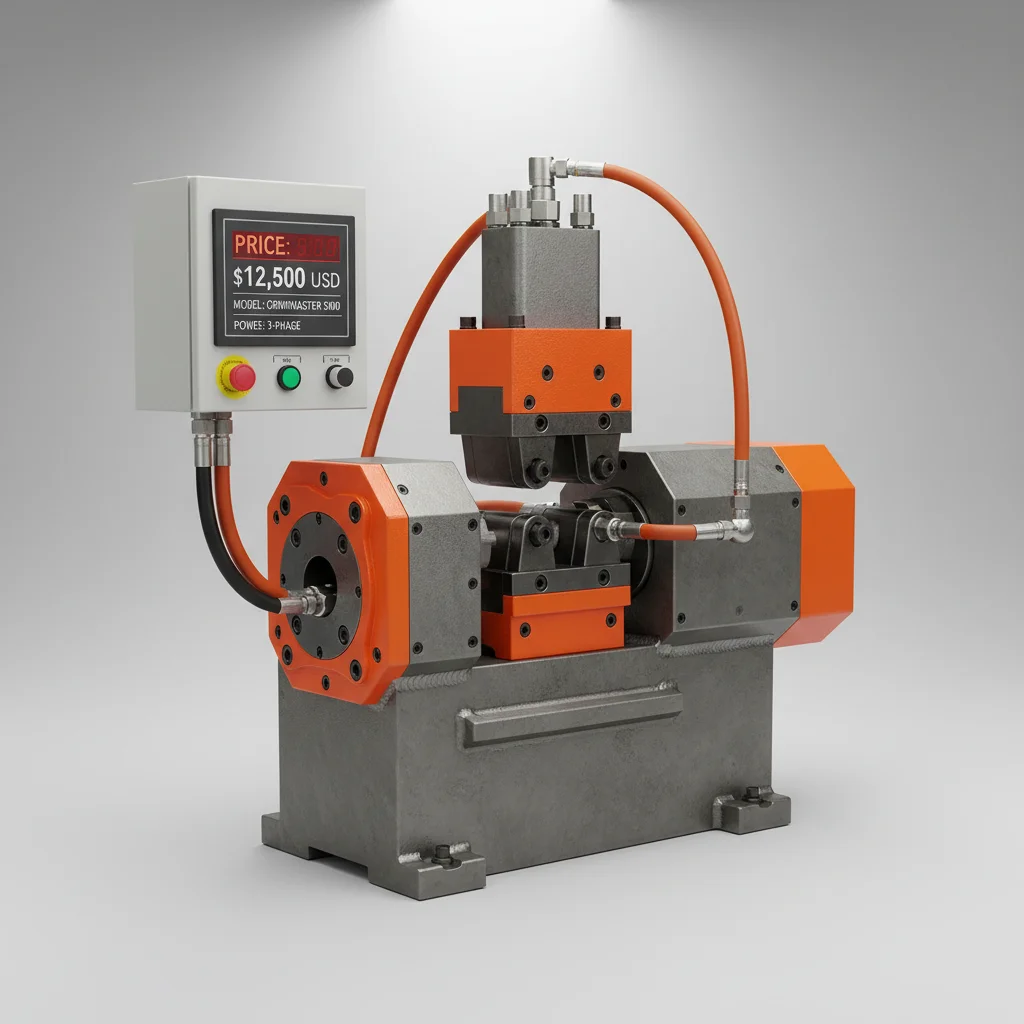
When calculating the total cost of ownership for a hydraulic assembly line, the initial hose clamp machine price is often just the starting point of a much larger financial equation. For workshop managers and procurement officers, the real challenge lies in balancing the upfront capital expenditure against the long-term cost of leakage failures and production downtime.
The hydraulic equipment market is currently shifting toward high-precision, forged components that reduce the frequency of fitting failures. As pressure requirements in mining and construction machinery increase, the margin for error in hose crimping has shrunk, making the technical specifications of the machine more critical than the sticker price.
Understanding how structural integrity and pump stability influence the final assembly quality allows buyers to move beyond simple price comparisons and instead focus on value-per-crimp. This analysis explores the variables that drive cost and performance in modern crimping technology.

The Economic Logic of Hydraulic Crimping

The cost of a hose crimping machine is not a flat fee but a reflection of its capacity to maintain tolerances under extreme force. In industrial settings, the difference between a low-cost assembly tool and a professional-grade machine often manifests in the "leakage rate"—the percentage of assemblies that fail pressure tests.
When evaluating a machine's price, one must consider the cost of the forging process used for the crimping head. Forged steel components, such as those made from Cr40, offer significantly higher fatigue resistance than cast alternatives, directly impacting the machine's operational lifespan and the consistency of the finished product.
Technical Drivers of Machine Value
The primary technical driver of value in a crimper is the stability of its hydraulic system. A high-pressure silent pump is not merely for noise reduction; it is designed to minimize pressure drift during continuous cycles. For machines like the DZW-50WS, maintaining a steady 31.5MPa system pressure ensures that every hose, from 1/4" to 2", receives the exact required compression force.
Crimping force is the second critical variable. A capacity of 1650KN is necessary for heavy-duty 4SN hydraulic hoses, which are used in extreme environments. If the force is insufficient or unevenly distributed, the bond between the fitting and the hose can separate under the surge pressures typical of construction and mining machinery.
Furthermore, the versatility of the die system adds significant value. A modular system that allows for rapid switching between different diameters reduces downtime in multi-product workshops. The inclusion of a wide range of standard dies (such as those covering 15mm to 93mm) transforms a single machine into a comprehensive assembly station.
Structural Integrity and Leakage Prevention
The geometry of the crimp is the single most important factor in preventing fluid leakage. Even a slight deviation in the radial compression can create a pathway for high-pressure oil to escape, leading to catastrophic system failure in the field.
A one-piece forged Cr40 steel head eliminates the structural weaknesses found in assembled or cast heads, ensuring that the 1650KN of force is applied with absolute symmetry across the entire circumference of the fitting.
This structural rigidity is complemented by dual-mode control systems. By integrating both foot pedal and button operations, operators can maintain a more ergonomic workflow, which reduces human error during the positioning and triggering of the crimping cycle.
Performance Index by Application
Different industrial sectors demand different performance priorities. A mining workshop focuses on maximum force and durability for large-diameter hoses, while an automotive repair shop prioritizes speed and a compact footprint for smaller, frequent jobs.
When assessing the value index, we look at the relationship between throughput (pieces per hour) and the reliability of the seal. High-efficiency machines can reach 200pcs/h while maintaining a low thermal drift in the hydraulic oil, ensuring the last assembly of the day is as precise as the first.
Figure 2. Comparative Value Index by Application Requirement
Operational Deployment Scenarios
In a typical industrial setting, such as a construction machinery maintenance hub, the crimper must act as a bridge between mass production and on-site repair. This requires a machine that is compact enough to fit into a mobile service van but powerful enough to handle 2-inch 4SN hoses. The DZW-50WS balances these needs with a chassis that provides high rigidity without occupying excessive workshop floor space.
For manufacturers evaluating their assembly line, the integration of pre-assembly machines and cutting equipment is essential. The workflow usually begins with a Hose Cutting Machine, followed by a Connector Pre-assembly Machine, and finally the crimping process. This streamlined approach minimizes material waste and ensures that the hose is perfectly squared before it enters the crimping head.
Evolution of Crimping Precision
The industry is moving toward "intelligent control," where the crimping force and depth are monitored in real-time via sensors. While manual and semi-automatic machines remain the backbone of most workshops, the shift toward data-driven maintenance is allowing companies to predict when dies are wearing out before they cause a failure in the finished hose.
Another significant trend is the use of advanced materials for the dies themselves. Heat-treated alloys are replacing standard carbon steels to extend the life of the die set, especially in workshops processing abrasive or reinforced synthetic hoses. This reduces the long-term operational cost, effectively lowering the "true" price of the machine over its lifecycle.
Environmental considerations are also influencing design. The adoption of high-efficiency, low-noise pumps reduces the electrical load and creates a safer, quieter working environment for operators, which is increasingly mandated by international occupational health and safety standards.
Selection Framework for Procurement
Selecting the right equipment requires a trade-off analysis between the maximum hose diameter required and the volume of daily production. A machine capable of 2-inch crimping is a versatile investment, but it must be paired with a pump that can handle the associated pressure without overheating during long shifts.
Procurement officers should evaluate the "Die Range" as a primary metric. A wide range of available dies means the machine can adapt to new product lines without requiring a complete equipment overhaul. For example, a range from 15mm to 93mm covers the vast majority of industrial hydraulic applications.
Finally, after-sales support and technical availability are non-negotiable. The ability to source replacement dies or pump seals quickly is the only way to ensure that a machine's downtime does not become a bottleneck for the entire production facility.
| Requirement | Critical Parameter | Recommended Spec | Impact on Value |
|---|---|---|---|
| Heavy-Duty Mining | Crimping Force | ≥ 1600 KN | High reliability in extreme pressure |
| High-Volume Batch | Work Efficiency | ≥ 200 pcs/h | Lower cost per unit assembly |
| Mobile Repair | Net Weight / Size | < 250 kg / Compact | Increased operational flexibility |
| Precision Fitting | Head Material | Forged Cr40 Steel | Minimized leakage and failure rate |
| Diverse Hose Sizes | Die Versatility | 1/4" to 2" Range | Reduced need for multiple machines |
| Quiet Workspace | Pump Type | High-Pressure Silent | Improved operator health & safety |
Questions & Answers
A forged head, typically made from materials like Cr40 steel, is created by compressing the metal under immense pressure, which aligns the grain structure and eliminates internal voids. This results in far greater structural strength and resistance to deformation. In practical terms, this means the crimping force is applied more uniformly across the hose fitting, significantly reducing the risk of asymmetric compression and subsequent fluid leakage compared to cast heads, which can have microscopic porosities.
The key is the quality of the hydraulic pump and the cooling capacity of the system. Look for machines equipped with high-pressure silent pumps that are rated for continuous duty. These pumps are designed to maintain a steady output (e.g., 31.5MPa) without significant thermal drift. If the oil temperature rises too high, the viscosity changes, which can lead to inconsistent crimping depths. A pump designed for stability ensures that the 1650KN force remains constant throughout the production shift.
Actually, investing in a comprehensive set of dies reduces the long-term cost by eliminating the need for multiple machines. While there is an initial cost for extra dies, the ability to switch from 1/4" to 2" hoses on a single machine saves on floor space, energy, and maintenance. The use of quick-change die systems further optimizes this by reducing the downtime between different hose orders, thereby increasing the overall throughput of the workshop.
Force requirements depend on the hose wall thickness and the fitting material. For heavy-duty 4SN hydraulic hoses up to 2 inches, 1650KN is generally the benchmark for creating a permanent, high-pressure bond. If you are working with lightweight industrial hoses or small diameters, this force is more than enough. However, for extreme high-pressure applications in mining, ensuring the machine can hit this peak force consistently is critical to prevent the fitting from blowing off under load.
Neither is strictly "better"; rather, they serve different needs. A foot pedal allows the operator to use both hands to align the hose and fitting perfectly within the dies, which is essential for precision and safety. Button control is often preferred for automatic modes or when the operator needs to maintain a specific grip on the assembly. The most efficient machines, such as the DZW-50WS, offer dual control, allowing the operator to switch based on the specific hose size and assembly complexity.
The most common misconception is that a machine that "works" is a "good" machine. Many low-cost crimpers can squeeze a fitting, but they cannot maintain the precision geometry required for high-pressure seals. The "hidden cost" of a cheap machine is the increased scrap rate and the risk of field failures. Professional equipment focuses on repeatable geometry and sustained pressure, which means the cost per successful assembly is actually lower than that of a budget machine that produces intermittent defects.
Final Thoughts
Evaluating a hose clamp machine price requires a shift in perspective from "cost of purchase" to "cost of failure." In the high-stakes environment of hydraulic machinery, the structural integrity of a forged Cr40 head and the stability of a 31.5MPa silent pump are the primary safeguards against costly leakage and operational downtime.
By prioritizing technical specifications—such as the 1650KN force capacity and a versatile die range—businesses can build an assembly line that is not only productive but also sustainable. The goal is to achieve a seamless transition from hose cutting to final pressure testing, ensuring that every assembly meeting the highest industrial standards.